Oldham’s Toxic Politics | Part 4 | Follow the money

This is the fourth in a series of articles which tells my first-hand experience of the current toxic politics putting a dark cloud over Oldham. Previously I have touched on the abuse, harassment, and intimidation, fed by hatred and division in the town. As the articles set out the consequences of the campaign, it was important to explain where and how it began.

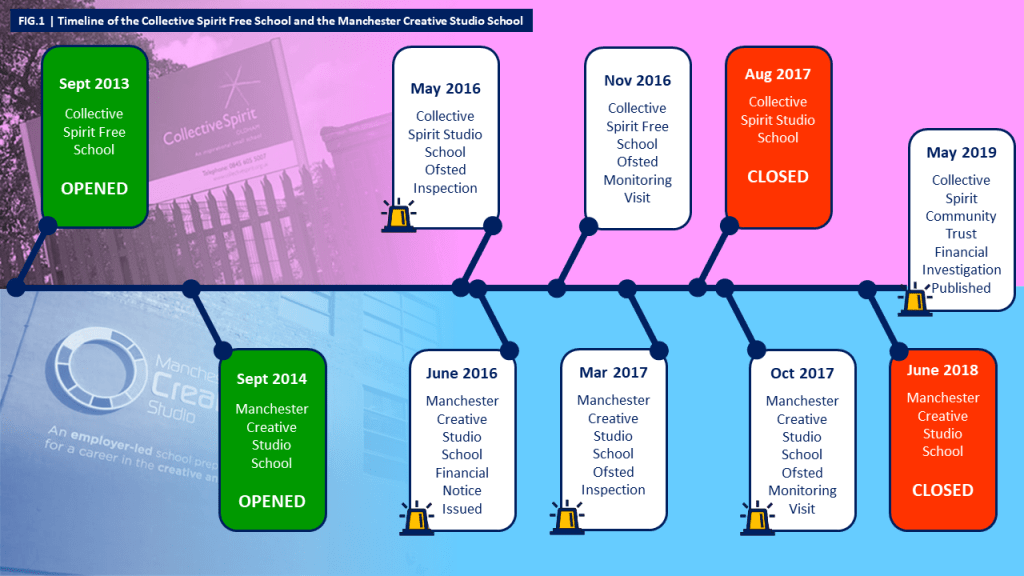
The previous post focused on the wide-ranging safeguarding and standards issues which besieged Collective Spirit Free School and the Manchester Creative Studio School. This article moves on to focus on the subsequent government intervention, and the official investigation which sparked the online campaign of abuse, harassment, and division in Oldham.

GOVERNMENT INTERVENTION

For months discussions took place between the Department for Education, the Regional Schools Commissioner and Members of Parliament. Following these ongoing problems, the government took steps to bring in new leadership to the school, removing the previous leadership including the governing body. However, as time went on it was clear the schools were not viable, not least of all because the finances of both trusts had been devastated, and as standards slipped so too did parental support.

The many promises of improvement at the schools never materialised, and so parents mobilised and demanded answers, and for any wrongdoing to be put right.

The matter was raised in debate in parliament, and it was following this exchange that the minister agreed to investigate the claims of financial conflicts of interests and alleged corruption.

Working with fellow MP’s including Oldham’s Angela Rayner & Debbie Abrahams, and Manchester’s Lucy Powell & Graham Stringer we continued to press for a full investigation.
FINANCIAL INVESTIGATION BEGINS
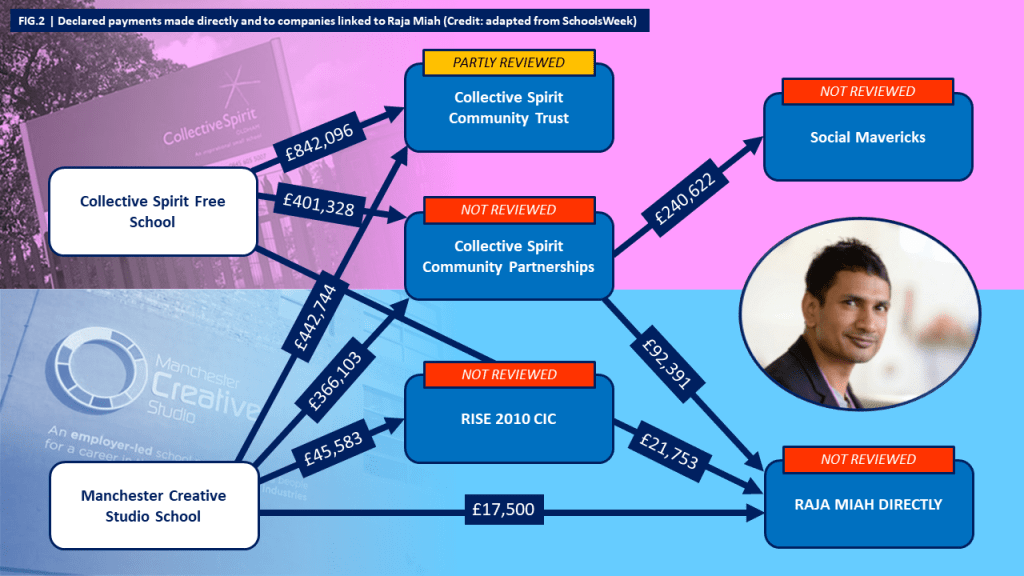
As the government sought to assess these allegations, the two schools were required to improve their reporting of ‘Related Party Transactions’ which gave the clearest indication of the range of trading companies involved, and the scale of payments made.

However, not long after reporting and oversight was placed under greater scrutiny, it’s CEO Raja Miah stood down from positions on both trusts. It was claimed that this was done to avoid the requirement to declare an interest, but he had fully maintained operational and financial control in the background, with others fronting as directors and shareholders in name only.

These allegations were later confirmed in an investigation carried out by the Department for Education.

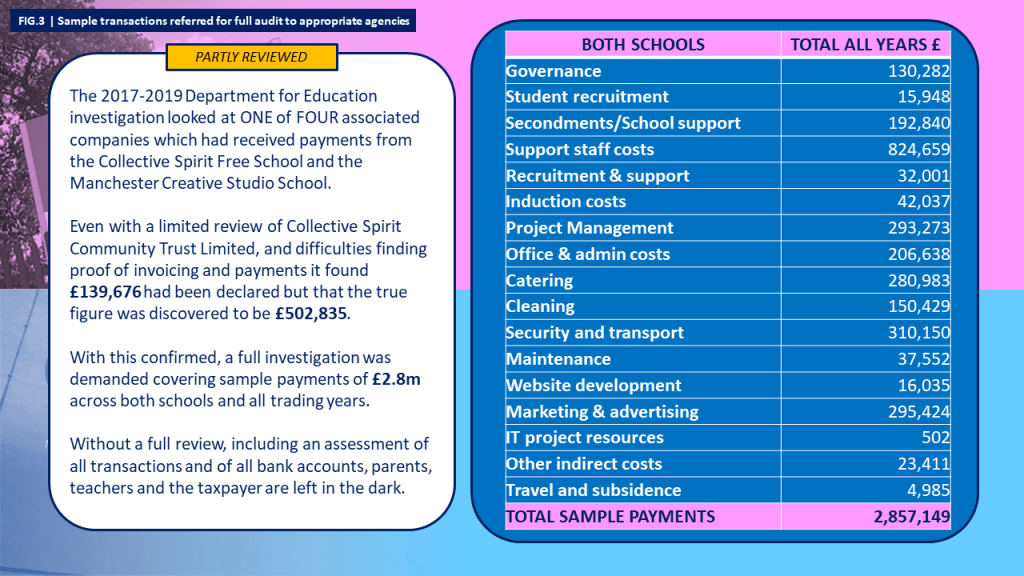
The sample review looked at just one company providing services to the schools, and covered just a single financial year; Collective Spirit Community Trust Limited.

The review considered the involvement of three individuals; Alun Morgan, Chair of Directors of both trusts; Raja Miah CEO of both trusts; and the former Chair of Collective Spirit Free School governing body Mohib Uddin.

The allegations made by whistle blowers were that money was paid to connected companies without being declared, and that some of that was for activity which was not carried out; essentially that they were fraudulent transactions. The investigation found that only £139,676 (27.7%) was declared, but that payments totalling £502,835 were discovered through the investigation. The allegation that payments were not declared was therefore proven to be true.

The investigation found:

• there was a failure to manage conflicts of interest, that key trustees failed to declare connections.

• that transactions with a connected party were not adequately managed or sufficiently disclosed.

• that the board of trustees failed in their duties as company directors.

• that there was a failure to comply with the financial accountability system for academy trusts including the relevant areas of HMT’s Managing Public Money and the Nolan principles which are selflessness, integrity, objectivity, accountability, openness, honesty and leadership.

What the review was unable to confirm, was whether money was taken for activity which wasn’t carried out. It is not the case that this was proven to be false, but it said; “robust financial control systems, adequate financial oversight and relevant documentation to support contractual management and financial transactions by the trusts has impacted upon the Education and Skills Funding Agency reaching any conclusion on the validity of funds paid to Collective Spirit Community Trust Limited.”

This was because contracts and invoices had either been removed or destroyed, or perhaps that they did not exist in the first place.

The review also found that operational staff were so concerned that they attempted to withhold payments, and that correspondence was found which confirmed staff had questioned why invoices were being submitted when there was no evidence that activity had been carried out. An instruction to make a payment was made by the Chair of the governing body, Mohib Uddin. The Education and Skills Funding Agency requested assurances that outstanding payments were compliant with the rules, this assurance was provided by Mohib Uddin in writing.

ESFA concluded that these assurances were inadequate, given what was discovered, and suggested that Mohib Uddin had potentially breached directors’ duties under the Companies Act 2006, by failing to act in the best interests of the trust.

Despite staff raising concerns, both Alun Morgan as Chair of Directors and Mohib Uddin as Chair of the governing body confirmed to the investigation that no specific work had been conducted by themselves or the boards to investigate staff concerns relating to invoice increases and potential lack of delivery of certain services.

The report suggests that this potentially breached the rules governing Academies and Free Schools, which states that trusts must take appropriate action where fraud, theft and/or irregularity is suspected or identified. What stood out as being odd, was that on interview, the Chair of Directors, Alan Morgan who stood as a 50% shareholder of the company said he had ‘limited knowledge of being a shareholder.’

It was alleged that the leadership of the schools made attempts to avoid declaring interests, for instance standing down from positions which required them to declare interests, but in truth, maintaining control in the background.

The review found that the former CEO, Raja Miah resigned as a director of both trusts in 2014 but continued to attend board meetings with board minutes confirming he would have oversight for finance and governance. It also found that he had clear connections with the company including personally chasing payment from the school as late as 2017.

Further, the investigation found that staff and new governors reported that school-owned IT equipment was retained by former trustees long after their official involvement had ceased.

MORE QUESTIONS THAN ANSWERS

However, what was abundantly clear was that the narrow scope of the review left more questions than it provided answers. The failure to conduct a full financial audit, including on company bank accounts, and that it only included one trading company in a single financial year was considered as part of the review, potentially missing confirmation of payment transfers.

The review did not investigate other related companies with Raja Miah as the sole shareholder, including Collective Community Partnerships, Social Mavericks, and RISE 2010 CIC.

A greater assessment of declared expenditure of both the Collective Spirit Free School and the Manchester Creative Studio School raised concern on transactions amounting to £2.8m.
As the dust settled on the Collective Spirit saga, and with pupils, parents and staff still affected by their experience, it was important that, despite the closure of the schools, they received the answers they deserved. Further complaints were then received pointing to organised VAT fraud relating to the Manchester Creative Studio School, using a side fire door as a postal address. The same address, which did not appear on the Royal Mail database, was also used for other limited companies with individuals associated with Raja Miah.

Because of this, the complaint was escalated to the Serious Fraud Office and latterly to Greater Manchester Police, supported by the National Education Union (NEU).

As the doors of the school are now locked shut, the consequences for those who worked in the school continued long after.

Former staff from Collective Spirit Free School have discovered their pension scheme had money missing, with resulting gaps in service, some only finding out they were affected as recently as September this year. So far evidence has been provided that 20 members of staff had missing pension contributions. As the school closed with just over £500 in its bank, a total of £178,741 remained unpaid to the pension fund, with the government ultimately intervening to settle the liability.

NO FUTURE INVOLVEMENT

The government conceded failures had taken place at the school and gave a commitment to taking steps to safeguard the public interest. This included writing to Raja Miah, Alun Morgan and Mohib Uddin ‘strongly discouraging them from future involvement in schools’, instructing the Regional Schools Commissioner to escalate any intelligence suggesting they had.

Despite the direction from government Raja Miah would go on to set up a new venture with the former school principal offering supply staff to schools, with a longstanding associate and property developer as the majority shareholder.

The Supply School LTD was found to have made unlawful deductions from staff wages in an employment tribunal which was reported in August 2019. Despite this apparent evidence of trading, ‘Dormant Accounts’ were submitted to Companies House.

The continued involvement in schools angered former staff, who felt let down by the government and without the justice they had been demanding.

ON PUBLICATION, A WAR BEGAN TO RAGE

As this episode was ending, a new front was opening up. After years of pressing for action, and with no contact or interaction with those running the school, things changed dramatically.

It was within weeks of the investigation report being published that Raja Miah, supported by Mohib Uddin, began directing an online campaign against me and those associated with me, in what Raja Miah describes as an act of revenge.

Though where the online campaign started is quite different to where we find it today.

Over a two-and-a-half-year period the campaign has created a toxic and dangerous political culture in Oldham leading to abuse, defamation, and death threats.

The next article will set out where the online attacks began, and how previously disparate interests came together.
Oldham’s Toxic Politics | Part 3 | Failing Free School

This is the third in a series of articles which tells my first-hand experience of the current toxic politics putting a dark cloud over Oldham. Previously I have touched on the abuse, harassment, and intimidation, fed by hatred and division in the town. As the articles set out the consequences of the campaign, it was important to explain where and how it began.  

These posts will first explore the introduction and failure of a Free School, the subsequent government intervention, and the official investigation which sparked the online campaign of abuse, harassment, and division in Oldham. 

SAFEGUARDING FAILINGS 

For Collective Spirit Free School, the range of complaints related to safeguarding was growing. For any school it would be a concern, but this was only a small school with just over 200 pupils. Reports included violence against pupils; an assault against a child by a member of staff, and that at least two members of staff had been accused of acts which sexualised young people. This included a confirmed example of a male member of staff placed on an ‘improvement plan’ after it was discovered he had observed girls changing, he was only removed from the premises after being caught for a second time. 

These accounts are deeply concerning, but it is important to remember that many of the staff were trying hard to provide support to pupils at this troubled school. 

Further, it was claimed that the school did not carry out safeguarding checks on incoming staff, allowing for at least one example of a member of staff who had previously been dismissed for a serious safeguarding breach, it is alleged that this was only discovered on a visit by a government education official who recognised the individual.  

The allegations went further to suggest that the safeguarding register was falsified to mislead inspectors into believing checks had been carried out. 

The most concerning case related to a pupil at the school. There is very limited information which can be placed in the public domain to ensure the identity of the victim is not compromised. However, what can be said is that a Serious Case Review would later find that the lack of robust safeguarding standards at the school contributed to the prolonged sexual abuse of a pupil. 

In response to a previous post, the school’s former CEO Raja Miah took to his podcast to claim; “The safeguarding concerns were raised by McMahon maliciously, falsely, and I was found to be at fault of nothing to do with safeguarding, Zilch. Financial irregularities. Again, nothing Zilch.” 

The extent to which Raja Miah had effective management of Collective Spirit Free School and its sister school the Manchester Creative Studio as CEO is something he has failed to fully explain. All the concerns raised by Ofsted related to the schools are a matter of public record and have received wide coverage in local and national press. The individual cases have been provided through a whistle-blower who provided a contemporary school record of incidents. All these complaints, which had been shared by parents and teaching staff, were referred by me in my capacity as a Member of Parliament to the appropriate Local Authority Safeguarding Unit, and to Greater Manchester Police.  

A RAPID DESCENT ON STANDARDS 

As concerns escalated, so too did calls for action on the Collective Spirit Free School and the GM UTC (Greater Manchester University Technical College). As the constituency MP for the two establishments, I had been in regular dialogue with the Regional Schools Commissioner and government ministers on supporting pupils, and in raising specific concerns. 

The GM UTC was closed after just two years, with reports that not one single pupil achieved GCSE’s A-C in English, Maths and Science. Ultimately the failure to attract pupils to fill it’s 600 capacity meant the £14m project ended abruptly. After many years of work, and significant lobbying to central government the building was used as a temporary facility for pupils later displaced by the closure of Collective Spirit Free School, before being transferred to Oldham College. Nationally a host of other UTC’s came to the same fate, closing after just a few years. 

For Collective Spirit Free School, the descent was far more dramatic; as complaints from parents and teachers mounted, inspections catalogued failures here and at its sister school, the Manchester Creative Studio School. 

An Ofsted inspection carried out in 2016 provided the most serious evidence that the Collective Spirit Free School wasn’t just struggling, but that pupils were being placed at risk, judging it to be ‘Inadequate’ in every area. 

Worryingly the Ofsted inspection raised further questions about the allocation of resources, with emerging allegations that funds were being taken from the school into companies owned by, or with direct conflicts of interests of its CEO Raja Miah and Chair of Governors, Alun Morgan. Concerns on payments being made continued on the appointment of its new chair, Mohib Uddin.  

Concerns were raised about the building contracts, security & cleaning contracts, and catering provided to the school, among others. 

The quality of school meals, provided through a catering company associated with Raja Miah was criticised, with Ofsted reporting that pupils were banned from bringing in lunch, instead having no choice but to use the onsite catering. However, it concluded that the food was so inedible that children would throw it away and go hungry, adding to a lack of concentration which disrupted learning even further.  

It was reported that the school didn’t have a library, nor suitable books, and that the school did not make use of the local public library either. It went on to say that teaching was so poor that it would affect pupil behaviour, highlighting too the excessive rate of exclusions. 

The following year its sister school, Manchester Creative Studio School, also run by CEO Raja Miah, received an Ofsted inspection, again being judged to be ‘Inadequate’ in every area. It found significant problems including serious and widespread failures in the school’s safeguarding arrangements, leaving pupils unsafe. It reported that there were significantly poor standards of teaching, and profound failures of the governing body to address ‘far-reaching failures across the school.’ 

The inspection also found the school was failing to support the most vulnerable and at-risk children, saying that nearly 40% of disadvantaged pupils were regularly missing from school. 

The matter was raised by me and other MPs in Parliament, and for some time we were met with indifference and secrecy by the Department for Education. 

Collective Spirit Free School was placed in Special Measures and subsequently issued with a financial notice. Aside from the spider’s web of transactions, the immediate concern was drawn to the safety of, and support given to pupils.  
 
GIVING A VOICE TO THOSE AFFECTED 

On the closure of the Collective Spirit Free School my office worked to support parents and pupils adjust to a new school, with Oasis Academy agreeing to take on those who were displaced. Months of negotiation took place where we would make recommendations to government to provide catch up support, financial support for new uniforms, and support to address transport issues. 

As the school closed its doors the pupils, parents and staff were left to pick up the pieces and to try and move on. For some this proved extremely difficult, and the voice of those affected should be heard. 

Parent A said, “I once had a high achieving, happy, confident son. I now have a very miserable young man who doesn’t want to go to school anymore. He is very anxious a lot of the time and I am very worried about his mental state.” 

Child A said, “I’m at the point where I feel like I’ve been robbed. I don’t want it to happen to anyone else. I’ve had my education ruined.” 

Parent B said, “My child used to attend the school prior to its closure. I feel that those responsible need to be held accountable for the ongoing trauma suffered by former pupils. Particularly vulnerable pupils. I believe until a full large-scale review is undertaken the parents and pupils will not be happy as the issues surrounding the school were on many fronts. Including mismanagement, misappropriation of funding, poor education, safeguarding to name a few.” 

A letter signed by 86 of the parents at the school set out the impact; “Naturally parents have been deeply upset and frustrated by the promises that have been made and these have not been forthcoming nor has there been any clarity from the local authority and the DfE.” 

“As parents of pupils who attended Collective Spirit, we have been badly let down by the DfE and as a consequence the educational progress and attainment of our children has drastically suffered. This will have a significant impact on the life chances of our children.” 

“We would also like the DfE to fully investigate the financial probity of the collective spirit trust, as we personally believe serious questions needs to be raised with regards to the financial management of the school and its CEO. We are disappointed that thorough due diligence was not carried out on the trust members and the CEO which has led to the collapse of collective spirit.” 

As time passed on the pupils reached the end of their school experience, Oldham Council conducted a review to establish the extent to which pupils had fallen behind, and the continuing impact it had as they progressed to complete their secondary education. The report showed that not only did the pupils fall behind when compared to their peers previously at the same level, but that they never recovered, with it impacting on their exams and having huge consequences on their educational outcomes.  

SCHOOL FAILINGS THROUGH TO FINANCIAL CONCERNS 

The next post will set out the concerns raised on financial conduct, and the resulting investment, together with the numerous outstanding questions. 

It will then move on to a further post covering the two-and-a-half-year period the online campaign has been running for, which has created a toxic and dangerous political culture in Oldham leading to abuse, defamation, and death threats. 

Oldham’s Toxic Politics | Part 2 | Educating Oldham

This is the second in a series of articles which tells my first-hand experience of the current toxic politics putting a dark cloud over Oldham.

Before rushing into the online content which has dominated much of the focus, it is important to take a step back, and set out the catalyst which drove the campaign. The beginning of the attack campaign was some years in the making before it appeared in plain sight, and this is where I will begin, because of the length of this piece, I will split it into two sections, with the second part to follow.

A FIGHT FOR SCHOOL INVESTMENT

For many years the council and schools in the town were reconciling three significant challenges; the first was the poor standard of education and outcomes, the second was the poor standard of school buildings, and the third was the low levels of interaction with young people from different backgrounds, with too many secondary schools drawing increasingly segregated cohorts from the White and Asian communities.

As the lessons from the Oldham Riots were repeated in both the Richie (2001) and Cantle (2008) reports, it was clear that as the self-selected segregation in neighbourhoods from both the Asian community and White community continued, there were few opportunities for young people from different backgrounds to mix, understand one another and to build friendships which transcended race and religious differences. This was termed ‘parallel lives’ by one report author, Ted Cantle.

And so, a programme of school reform was set, bringing together a number of smaller secondary schools to merge to form new academies under the Building Schools for the Future initiative.

It was supported by a range of other investment including the primary school twinning programme, the establishment of the University Centre Oldham, and the Regional Science Centre.

The programme was not without tension, both in the insistence that new schools had to be run by national academy chains, not under the local authority, and in the selection of new sites for the replacement schools.

Over the years the programme brought together the former St. Augustine’s School with Our Lady’s School to create the Blessed John Henry Newman RC College. The same programme saw the merger of Counthill and Breezehill schools to create Waterhead Academy. The merger of South Chadderton School and Kaskenmoor School led to the building of the Oasis Academy at Hollinwood.

It was also the intention to rebuild a number of secondary schools including North Chadderton, Saddleworth, Blue Coat, Crompton House, Royton & Crompton, and Hathershaw School, complimenting work already undertaken to build new schools for Failsworth School and Radclyffe School.

Throughout the period, though there were differences on the selection of school sites, there remained cross-party support, from the Labour controlled council to 2008, the Lib Dem controlled council to 2010, and latterly the Lib Dem/Conservative controlled council, before Labour regained control of the council in 2011.

A CHANGE OF GOVERNMENT

As the new coalition government took office in 2010 the school rebuilding programme hit a block with just 5 of the 13 schemes approved. Though investment totalling £137m was welcomed, it meant only those proposed to be merged and the North Chadderton School rebuild went ahead, with others seeing the promised investment pulled. This left pupils and school leaders with deteriorating buildings, some with critical health and safety issues.

The same government also ended the £25m annual Area Based Grant, which had been used to fund key projects, including building the Regional Science Centre, and a range of social investment programmes.

The council kept up the fight for additional investment with some success, as funding was secured for a range of new schools and improvements to existing schools.

To address the growing fragmentation of education provision in Oldham, and to create a new partnership I asked Baroness Estelle Morris to undertake a review. Over months discussions took place to develop a new way of collective school leadership across all schools, colleges, and partners. I believe this report was the foundation to a decent education system in the town.

The desire to build a new education partnership was soon overtaken by the insertion of the Governments ‘Area Opportunity Board’, which it claimed would see investment focused on improving outcomes for pupils. The board has been allocated over £9m over five years, but this is in the context of Government school funding cuts of £58m in the same period – equivalent to losing £298 per pupil.

OPENING THE DOOR TO NEW ENTERPRISE

As the government changed focus, it ramped up efforts to wrestle control of schools away from local councils, in favour of untested private sector and not for profit sponsors. For Oldham this meant opening the door to Free Schools which threatened to undermine efforts to create mixed schools, and which shifted the focus of investment away from addressing the poor standard of existing facilities.

For years consultations would appear from groups seeking to open new schools. It included proposals to open a school run by unqualified teaching staff in favour of former armed forces personnel.

The nature of confusion for the council and other schools in the area was significant; for instance, the Phoenix Free School project referenced above had been rejected by the government in 2012, approved in 2013 and later rejected again in 2014.

As the rush for Free Schools came, so too did claims on public land and buildings as possible locations for the new schools, some of which were required to part-fund the Building Schools for the Future programme, including South Chadderton School and Kaskenmoor School. Transferring these assets to untested new schools didn’t just compromise a public asset, it blew a hole in funding for schools which already had projects approved.

For Oldham the change in government focus meant funding being diverted to two projects; Greater Manchester University Technical College (GM UTC), which would be based on land owned by Oldham College, and the Collective Spirit Free School, as a sister school to the Manchester Creative Studio School.

This second venture staked a claim on the former South Chadderton School site, with RISE 2010 CIC, a company owned by the school CEO Raja Miah, facilitating the bid. The company had previously been contracted to deliver ‘resilience building of communities to exploitation from extremists through the fall out of sexual grooming cases’ in South Yorkshire. He would be acutely aware of both the tactics deployed by the far right, and the impact felt when a whole community, race or religion was targeted by those seeking to spread hate and division.

The company was struck off by Companies House as the doors opened on Collective Spirit Free School, with trading companies established which would provide services directly to the school including Collective Community Partnerships and Social Mavericks Limited.

EARLY CONCERNS

Concerns were raised early about the establishment of both schools. On the former, that the proposal to admit pupils from 14 years old onwards would disrupt, not enhance education, and that the school system couldn’t plan across years with the uncertainty of losing pupils midway through their secondary education. There were also concerns that funding and land which should have been used to repair the crumbling college estate was being diverted, at a time when austerity had kicked in.

For Oldham College this had a significant impact. The proposal to build a new college campus was scrapped by the coalition government, and to add insult to injury the UTC would be built on its land with a new building standing alongside others which were propped up with steel reinforcements to prevent them falling down.

For Collective Spirit Free School, the proposal raised concerns because of the inexperience of the leadership team involved, the proposal was to use a former school which had been merged to facilitate greater mixing and cohesion, and that the condition of the building was too poor to continue using as a school, raising concerns about the safety of the pupils attending.

As time went on it became apparent that both institutions were struggling to attract stable leadership, teaching staff and pupil numbers. In addition, reports had been made that the standard of teaching was increasingly becoming a concern.

Those few voices of concern grew into a collective demand for action, with highly damaging allegations of corruption, conflicts of interests and safeguarding failures.

The pupils, parents and staff deserved to have their voices heard, and I was determined to support them.

*****

The next post will explore in more detail the rapid descent into failure, government intervention, and the investigation report which sparked the campaign of harassment and abuse in Oldham.

Oldham’s Toxic Politics | Part 1 | Introduction

THE CHANGING POLITICAL ENVIRONMENT

Social media acts as more than a platform, it is an active facilitator of abuse, harassment, and radicalisation. The self-moderation afforded to Twitter, Facebook, and YouTube (though there are many others) is not something other parts of our media have the luxury of. Newspapers are covered by press regulation, and though some argue it should be tougher, there is at least a body to complain to, and the same is true of TV advertising. Its beggar’s belief that my child watching the TV is protected by a 9pm watershed barring bad language, but they can see obscene abuse, false accusations, and death threats against their political parent.

Complaints to platforms, which can run into hundreds of individual complaints, too often don’t even get a reply, and worse some platforms such as Twitter have separate rules for public figures which allow a significantly greater level of abuse, not just accepting that it is part of the job, but actively encouraging it.

Current measures and proposals to reign in social media giants to a level playing field fall short in my view, not just at protecting individuals but to protect the fragile balance of our democracy. My longstanding personal view is that adding another level of oversight isn’t enough, for a true level playing field platforms should have the same legal responsibly as print and TV media; that they themselves are the publisher. This would change the approach by the platforms overnight and when faced with a long line of likely defamation, harassment, and abuse claims, they would soon clean up their act.

I am fortunate that I do not attract the sustained abuse faced by many in politics, including journalists and leading campaigners, especially women and those from minority backgrounds. But even with this every MP has faced threats, sustained abuse, and harassment which with the best will in the world, impacts on how we carry out our role.

AN OLDHAM PERSPECTIVE

In Oldham we have been faced with a near three-year long divisive campaign of misinformation, abuse, harassment, and threats to safety. It has made the political discourse toxic, threatening and dangerous. Though recently this has been covered in national newspapers; it is important this experience is told first-hand.

Most of the content is originated by Raja Miah, a failed former Free School CEO who was taken to task over safeguarding and allegations of financial irregularities at the schools he ran. Miah is currently on police bail for Racially Aggravated Public Order and Malicious Communications offences, but is welcomed onto platforms including Facebook, Twitter, Youtube and is freely drawing in subscriptions and donations for his content through Buymeacoffee, Paypal and Crowdfunder UK.

The real consequences of this online campaign of hate are profound. It affects all local MPs, our staff, family, and friends. For my own part I have reported threats of my partners workplace being published, photos of my children being used in attacking posts, our home address being solicited and shared online, our movements when campaigning have been published with encouragement to turn up and confront us. My own family members have been singled out for abuse and harassment when they did not choose to come into political or public life.

And it goes beyond Members of Parliament. The campaign to target the former council leader with the most horrendous false claims that he was covering up child abuse in the town lead to intimidating protests outside his family home, abuse in the street and ultimately in his defeat at the ballot box. It is the same relentless campaign which has now driven him out of the town where he was born and raised.  

With a new council leader in post, her ethnicity and religion are used to attack her further, with accusations that as an Asian Muslim woman, she represents a Muslim takeover of the town, and she does not have the interests of all Oldham at heart. Even on the firebombing of her car in what appears to be a targeted attack, countless posts followed, including comments that she should have been burned alive and had her family home set on fire.

Throughout the course of the misinformation campaign several journalists have observed the growing conflict and stepped up to shine a light on it. The cost for some has been significant in personal abuse where they themselves are labelled as paedophiles and accused of being part of the fabricated conspiracy. Some have been threatened with being hunted down, and some with violence. Anonymous accounts set up solely to harass, defame and conduct organised pile on attacks.

We have reported countless threatening messages and posts, though frustratingly, this is rarely taken seriously, and complaints submitted to date have largely been ignored.

FROM ONLINE TO ON STREET

In the last month alone whilst out campaigning, we have been threatened, abused, and accused of the conspiracy peddled by Miah, namely that Labour politicians are part of a conspiracy to cover up child abuse to protect Asian abusers in return for votes, that the votes of white people are rendered worthless through organised cartels operating voter fraud, and that there is widespread corruption.

It isn’t the case that there is never action, for those incited by the content who make overt threats to life, the response from authorities has been robust. Only a couple of weeks ago a man was sentenced at Manchester Magistrates Court for making threats to kill me in a series of direct messages, which caused great distress to me and my family, all of which was incited by the divisive and hate filled content published online.

But failing to address the very content which incites hatred, and which is itself unlawful, erodes the standards of democratic discourse which is now near breaking point. That there is now ample evidence that it hasn’t just led to abuse and intimidation, but more that is has had a material effect on our democratic process. This should have been a wake-up call.

Without social media platforms, the police and the Crown Prosecution Service taking a more consistent and proportionate response, it is a fact that public life and democracy is diminished.

UK DEMOCRACY IS UNIQUE; WE SHOULD VALUE AND PROTECT IT

As local MPs we value the face-to-face support we offer constituents, and I take personal pride in the individual casework support we give, mainly thanks to the hard work of my team in Oldham and London who work tirelessly to support local people.

In the past year we have supported around 8,000 cases; from people making contact about a campaign they care about, or the most dire personal circumstances where we are the last line of defence. Whatever follows is less about individual MPs but more about ensuring those we came into politics to support don’t feel more disconnected, alone and with nowhere to go.

Even at the height of the awful pandemic we never stopped, in fact we ramped up our efforts to support local people. When we weren’t working through casework, offering video and telephone surgeries and meeting officials to support the efforts, we were full shoulder to the wheel in delivering food parcels, homeware items and door to door community testing. Without this community grounding, politics is poorer, politicians more remote and parliament even more removed from everyday life experiences.

And it must be remembered that though we are sent to be your voice in Parliament, many of us are of the community we serve. When online abuse confronts you in the street, it also meets you at the local supermarket, in local parks, in the market hall and in local pubs and more. Intimidation then doesn’t just affect how you do your job, but how you live your life.

Of course, the vast majority of people we come into contact with just want to get on with life and don’t think about politics much at all, and for those who do, most experiences are nothing but positive. I am proud to live in Oldham and to represent the decent people who make up our rich community. It is that which we all focus on to keep the show on the road, but it doesn’t excuse the toxic environment being allowed to grow in plain sight.

THE START OF AN INSIGHT

I will go into the full circumstances of the Oldham political environment in upcoming posts; from where it began, to how it developed. I seek to outline what we all need to do to raise the level of debate from the gutter of division, and return to a more respectful discourse.

Labour calls on the Government to tackle HGV crisis

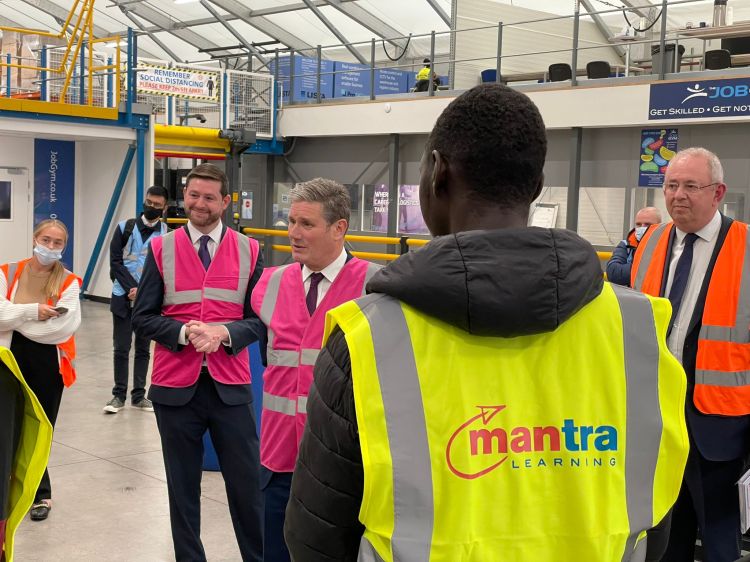
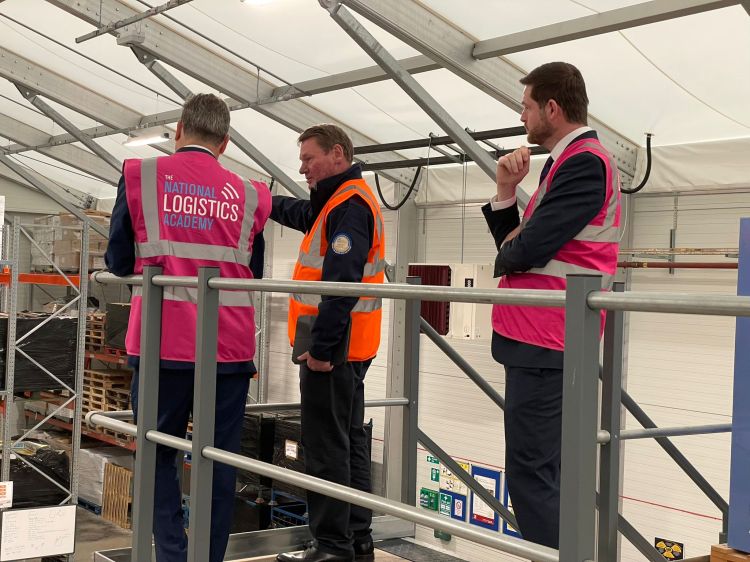
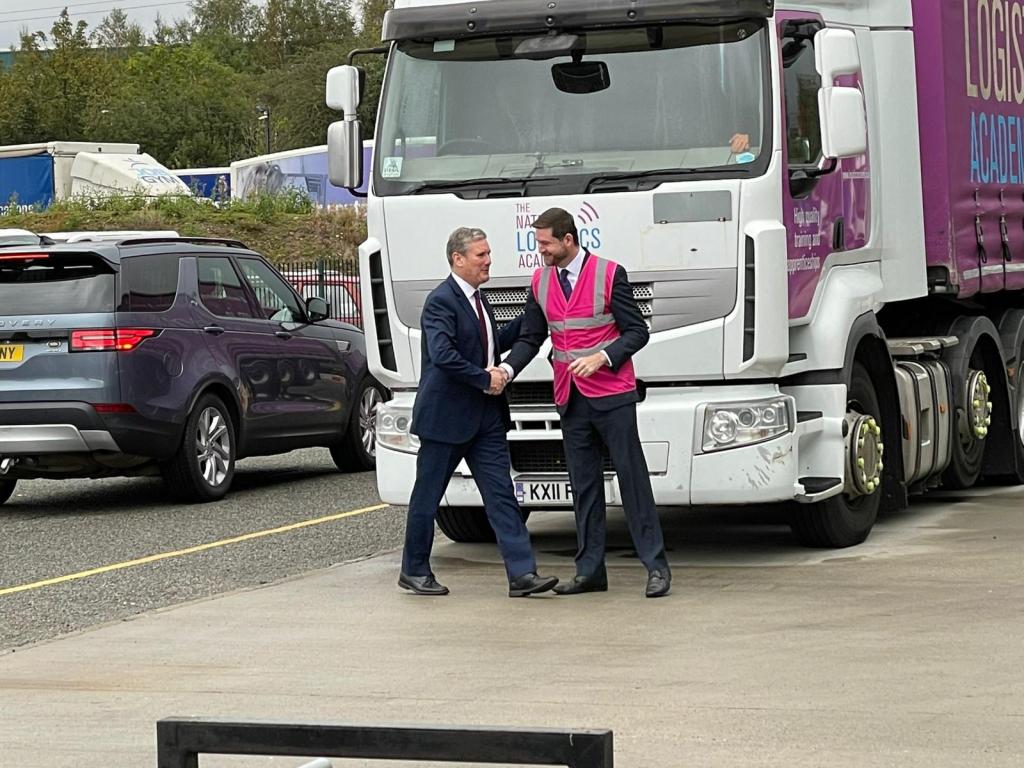
On a joint visit today in Oldham, Keir Starmer MP, Leader of the Labour Party and Jim McMahon MP, Labour’s Shadow Transport Secretary, call on the Government to get a grip on the HGV driver shortage.

Keir Starmer, Leader of the Labour Party, said:

“The haulage sector is trying to save Christmas, get medical supplies to where they’re needed and keep our forecourts open, whilst the government is missing in action with their out of office on. This is a crisis made in Downing Street but so far being mopped up by businesses and workers.

“The industry has warned they need 15,000 extra drivers to meet Christmas food deliveries alone, which a sticking plaster bootcamp scheme just isn’t going to deliver.

“This government must break the habit of their decade in power by acting with the urgency required before yet another Christmas is ruined by Tory failure.

“Ministers need to listen to industry to build a secure HGV workforce. They must set out how exactly they are going to attract people to training, including by listening to Labour’s plan to create more apprenticeships. And ultimately address how they are going to improve pay and conditions for this vital sector.”

Jim McMahon MP, Shadow Transport Secretary and Member of Parliament for Oldham West and Royton said:

“It’s great to welcome Kier to Oldham today to talk to industry experts on how we tackle the HGV driver crisis. Let’s face it the Government has completely failed to take this crisis seriously – we’ve already seen the consequences, with businesses struggling with supplies, medicines not delivered and dry forecourts in the last few weeks alone.”

“In the teeth of multiple unfolding crises of the Government’s making, ministers are missing in action, and the Prime Minister has gone on holiday.”

“If the government doesn’t act now, families could be left without the gifts they have ordered and the festive products they’ve been looking forward to, facing another Christmas ruined by Tory failure.”

Levelling Up Oldham

Responding to comments Michael Gove, Secretary of State for Levelling Up, Housing and Communities, made at Conservative Party Conference about Oldham, Jim McMahon MP for Oldham West and Royton said, “I welcome the Secretary of States sudden interest in Oldham but I think after 11 years of underinvestment in skills and jobs in our town I think it’s slightly too late.”

“This Tory Government could start by addressing the chronic underfunding of Oldham Council, the fact that the Housing Market Renewal Scheme was scrapped, and the fact that Building Schools for the Future was also scrapped, meaning people in Oldham just don’t have the same chances that people in other parts of Greater Manchester have.”

“I’ve lost count of the number of times during the pandemic I’ve written to the Government highlighting key health inequalities here in Oldham and the Government have responded with a template response and practically refused to engage with the substance of the issue at hand.”

After the Secretary of States comments Oldham MPs Jim, Debbie Abrahams and Angela Rayner wrote to him, urging him to tackle Oldham’s inequalities.

Jim McMahon calls for action on HMOs

Oldham West and Royton MP Jim McMahon has called on Oldham Council to act on the constant stream of applications for Houses of Multiple Occupation in the borough and implement a boroughwide policy to ensure residents’ concerns are not simple shifted from one district to the next.

In his response to the Oldham Local Plan Consultation, the Oldham MP wrote “Since the last consultation the prominence of Houses of Multiple Occupation has risen sharply, and I would press for action to be prioritised to address this head on.”

Jim McMahon said, “We’ve seen developers take advantage of the fact that the government has weakened local council’s planning powers when it comes to HMOs and it’s my strong view that Oldham Council can and should do more to implement a policy across the borough that seeks to address residents’ concerns about the proliferation of HMOs.”

“This is about getting the balance right and not concentrating problems in certain areas, we have to make sure that whole streets don’t end up saturated with HMOs and end up creating additional pressures and conflicts with local policies in areas like public health and transport.”

“I’ve long advocated that neighbourhoods should be helped to co-design the future of their place in a meaningful way, and a fundamental building block to doing this is to listen to the concerns that residents already have about the places where they live.”

Time for action on Block Lane drains

Oldham West and Royton MP Jim McMahon has written to United Utilities demanding accountability and a timescale on the completion of works for a blocked drain on Block Lane, Chadderton. The issue has been raging for over a year now with local residents complaining that no progress has been made.

Jim said, “There’s been back and forth discussions for a number of months now about who’s responsibility it is to sort this mess on Block Lane out. United Utilities said at the start of August they would send a camera down the drain to assess the situation and clean it if necessary.”

“It’s been more than a month since then and no further action has been taken, enough is enough. Residents shouldn’t have to deal with the smell, the sight and the mess that this blocked drain is causing.”

“It needs to be resolved so that’s why I’ve written to United Utilities asking for a plan and a timescale. This is the absolute basics, and it needs to be put right so that we can all live in somewhere pleasant and clean. Residents aren’t asking for anything out of the ordinary and they’re rightly annoyed that nothing has happened yet.”