John Robert Clynes, born on 27 March 1869, was a remarkable figure who transitioned from mill worker to trade unionist and senior Labour Party politician.
Serving as a Member of Parliament (MP) for 35 years, he led the Labour Party during its pivotal breakthrough in the 1922 general election, increasing the party’s representation from 85 to 142 MPs. Clynes went on to serve as Deputy Leader for a decade, became Minister for Food Control during World War I, and rose to the position of Home Secretary during the interwar period. He was also the Secretary of the National Gasworkers and General Labourers Union, which later evolved into today’s GMB Trade Union.
Books about JR Clynes are readily available, and a friend gifted me one on entering Parliament, sparking my interest in his early life and career. Local history fascinates me—it gives us a sense of pride, belonging, and connection to the places we call home. With that in mind, let’s trace Jack’s (as he was known) journey from a young piecer at Dowry Mill to his official residence at 11 Downing Street.
The young Clynes was baptised on 4th April 1869 at St Mary’s Church, Shaw Street. His godmother was Mary Elizabeth Parker. St Mary’s had opened in 1839 and remained in use up to 2018, serving the Catholic community for nearly 180 years. It has since been demolished.
𝟏𝟑 𝐁𝐚𝐜𝐤 𝐇𝐞𝐧𝐬𝐡𝐚𝐰 𝐒𝐭𝐫𝐞𝐞𝐭
Our story moves on to the 1871 Census, where two-year-old Jack lived at 13 Back Henshaw Street, in the modern Coldhurst ward covering the town centre, alongside his parents, Patrick and Bridget (née Scanlon), five sisters, a brother, and a cousin. This small street, made up of six houses, housed over 60 residents, including 23 who lived in the cramped cellars below. Most adults and children over the age of ten worked in Oldham’s booming cotton industry, while others found employment as labourers or domestic staff.
Nestled between Henshaw Street and Fountain Street—near Dan Fold and Priest Hill Street, near the site of the bus station and taxi rank behind what was the Snipe Inn.
During this era, Oldham showcased its industrial dominance with a skyline punctuated by towering mill chimneys and air filled with the constant hum of textile machinery. The district bustled with landmarks like the Victorian Market Hall, opened in 1855, and the adjacent Fish Market. Nearby stood pubs, mills, and the Oldham Free Library (opened in 1852, now the old Gallery) and Oldham Lyceum (1842), a testament to the town’s growing social and educational development. Expanding rapidly, Oldham added new housing, mills, and factories to meet the demands of its flourishing industries.
The area attracted workers from Lancashire, Yorkshire, and beyond, including a wave of Irish immigrant families fleeing the Great Famine (1845–1852). Among them was Patrick Clynes, who had been evicted from his tenanted land in Ireland. The famine led to the deaths of over a million people and forced another million to seek new lives elsewhere, with many settling in England’s industrial towns.
Living conditions in Oldham were tough. Families crowded into every available space, including the cellars, enduring hardships that extended to food scarcity. Meals often consisted of “bread, with butter when affordable, and lard or dripping when not; stews made from vegetables and scraps of meat, peas, and beans.” Life in these back-to-back homes was a harsh reality for many.
𝐀𝐥𝐞𝐱𝐚𝐧𝐝𝐫𝐚 𝐏𝐚𝐫𝐤
Patrick’s time in the mills was brief, as he began working for the Oldham Corporation as a general labourer. During the Lancashire Cotton Famine (1861–1865), Oldham, one of Lancashire’s key cotton-spinning towns, faced significant hardship. The American Civil War disrupted raw cotton supplies, causing widespread layoffs that left thousands of mill workers unemployed. In response, the Oldham Corporation launched a series of public works to provide relief, including the creation of a new public park spanning over 70 acres of recently acquired land.
Construction of the park began in 1863, and it was named Alexandra Park in honour of Princess Alexandra of Denmark. That same year, she married Prince Edward, who would go on to become King Edward VII.
𝐒𝐜𝐡𝐨𝐨𝐥
Jack attended the local board school alongside his school age siblings, which was a financial stretch to maintain, his father who could neither read or write himself, paying “a penny or two a week each for myself and my brother and five sisters, so that we should receive the education he had missed.”
It is fair to say Jacks experience of school wasn’t a good one, he recalled; “My schoolmaster taught me nothing except a fear of birching and a hatred of formal education.”
𝟗𝟖 𝐒𝐩𝐫𝐢𝐧𝐠 𝐒𝐭𝐫𝐞𝐞𝐭
By 1881, Patrick and Bridget moved outwards with the census record capturing the 12 year old Jack at 98 Spring Street, Waterhead with his three sisters (13,7,3), and brother (10). His older sister was working full time in a cotton mill, and Jack himself was two years into part time job working as a little piecer.
𝐃𝐨𝐰𝐫𝐲 𝐌𝐢𝐥𝐥
Jack’s part-time work led him to the Dowry Spinning Company at its Waterhead mill, where he laboured amidst 66,700 spindles. His day started at 6 a.m., repairing broken threads as a piecer—a critical role ensuring the spinning machines operated without interruption. After working until noon, Jack would attend school in the afternoons.
The job was fraught with dangers. Piecers navigated slippery, oil-coated floors and dimly lit spaces illuminated only by the bleak oil lamps. The relentless thunder of machinery filled the air, while the whirring jennies above posed constant hazards. Even the wooden floors added to the ordeal, with splinters piercing through his young feet as he worked tirelessly to tie broken threads together.
𝐆𝐫𝐞𝐞𝐧𝐚𝐜𝐫𝐞𝐬 𝐂𝐞𝐦𝐞𝐭𝐞𝐫𝐲
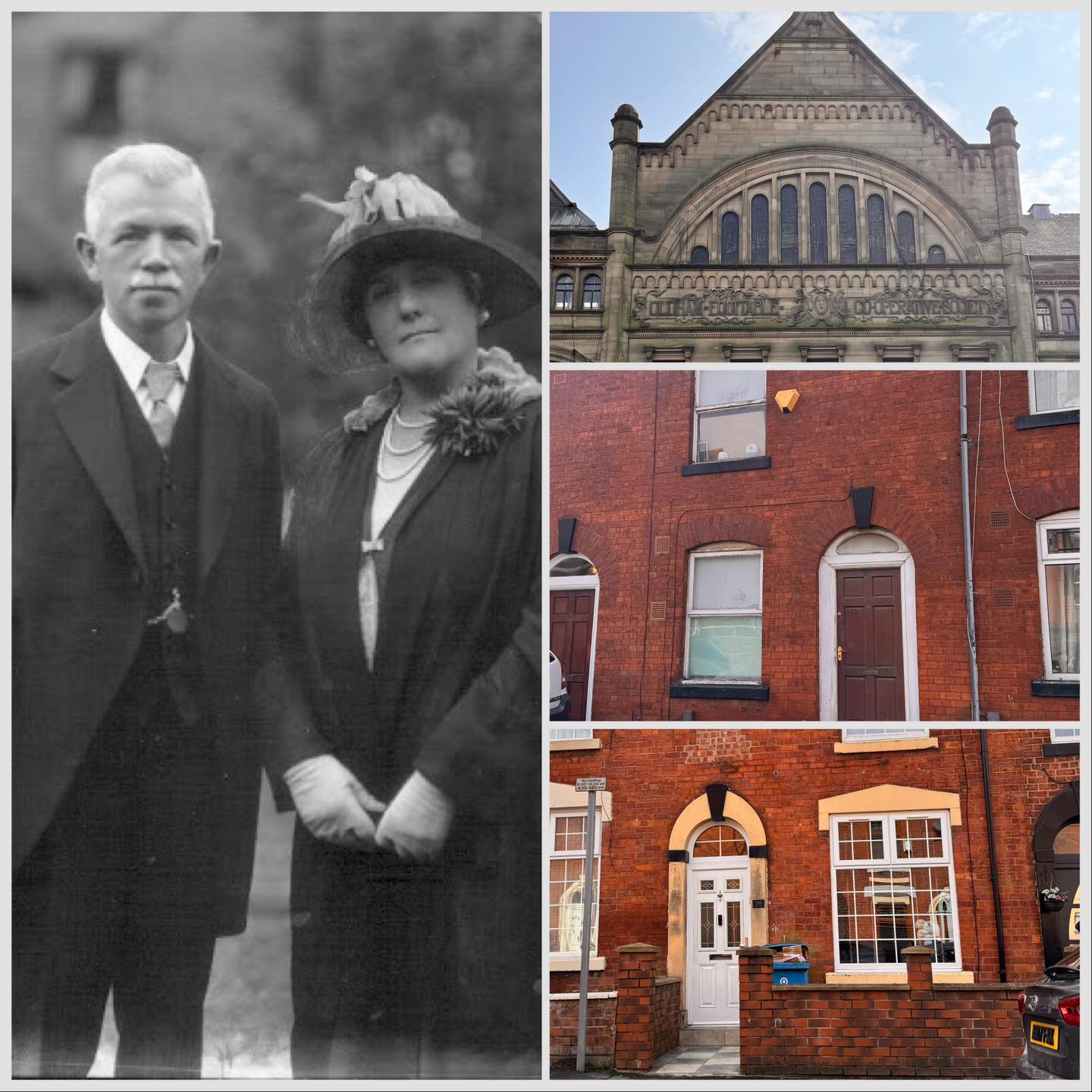
His father had stayed on with Oldham Corporation, and on completion of the new park continued as a gravedigger at Greenacres Cemetery, just a short walk down the road. The lower number terrace properties remain on Spring Street, but the Clynes house isn’t standing today, in its place much newer properties.
𝐎𝐥𝐝𝐡𝐚𝐦 𝐄𝐪𝐮𝐢𝐭𝐚𝐛𝐥𝐞 𝐂𝐨-𝐨𝐩𝐞𝐫𝐚𝐭𝐢𝐯𝐞 𝐒𝐨𝐜𝐢𝐞𝐭𝐲
Jack’s first book purchase—a dictionary—was a significant investment for the curious young boy, who used two weeks of personal pocket money left over after contributing to the family pot. For Jack, the dictionary was not just a book but sustenance for his hungry mind. His passion for learning grew during visits to Oldham’s second-hand bookshops and the reading room at the Oldham Equitable Co-operative Society.
While many frequented the reading room to scan the employment pages, Jack immersed himself in the works of Shakespeare and Dickens. In later years, when Jack rose to high office, his portrait fittingly hung in the library of the Oldham Co-op, facing a portrait of the librarian who had encouraged his pursuit of knowledge.
Jack’s fascination with reading, poetry, and language ran deep. He didn’t merely read; he absorbed and revisited the words, using them as an escape from the monotony of mill work. Books transported him to other worlds, providing a stark contrast to his challenging reality.
An especially formative experience for Jack came when he was paid by three elderly blind men to read newspapers aloud to them, likely the Oldham Chronicle, Advertiser, and Standard. These sessions often sparked lively debates, which are said to have planted the seeds of Jack’s political consciousness. The money he earned, alongside his mill wages, also allowed him to fund night classes.
By the age of 12, Jack had left school to become a full-time piecer in the mills. He later reflected on these harsh realities, writing: “On this stage, in the inconspicuous corner where Oldham stands, amidst a great fever of mill work, surrounded by poverty and disease, malnutrition and ignorance, a small boy, sullenly eager to escape from the brutal slavery of school to the merciless thraldom of the mill, was very anxious to quiet the rumblings of an empty belly by contributing to the home exchequer the few shillings a week that a ‘little Piecer’ could earn.”
It was this experience that inspired Jack to adopt the pen name “Piecer” when he began writing in local newspapers around 1885. Through his articles, he exposed the harsh working conditions in the mills and the devastating toll they took on workers “ruined by hard labour and poor working conditions.” Jack’s transformation from a reader of political and social discourse to a writer of it marked the start of his activism.
In his memoirs, he reproduced a letter that made a compelling case for working-class representation in Parliament: “If the workers want different laws, the workers also want different lawmakers… instead of forcing others to adopt their programme, it would be better for the workers to elect their own members to carry their programme out.”
From these early writings and his role in establishing the fledgling Piecers Union, Jack began speaking at meetings across Lancashire, gaining prominence among mill workers and setting the stage for his political ascent.
𝟓𝟏 𝐒𝐭𝐨𝐧𝐞𝐥𝐞𝐢𝐠𝐡 𝐒𝐭𝐫𝐞𝐞𝐭
By 1891, Jack was living with his sister Sarah, a cotton weaver, her husband Harry Parker, an iron moulder, and their two children at 51 Stoneleigh Street. The house still stands today, appearing much as it did when Jack crossed its threshold over 130 years ago. At the time, Jack was recorded as a cotton spinner, earning significantly more than he had as a piecer—two to three times as much.
Two years later, in September 1893, Jack married Mary Elizabeth Harper of Bury at St. Anne’s Church, Greenacres. He had met Mary five years earlier, as she was the sister of his friend Harper, a fellow cotton spinner.
Jack’s union work continued, though not without challenges. He recounted instances where police broke up meetings, some attendees were imprisoned, and all the while, Jack had to manage exhausting 12-hour mill shifts to make ends meet while organising events.
Around this time, Jack became involved with the National Union of Gasworkers and General Labourers. Within a few years, he was appointed as the Lancashire organiser, and he credited his friendship with Will Thorne—a transformative relationship—transforming him from cotton to politics. This enduring partnership was pivotal, and Jack took pride in growing the union’s membership from 2,000 to 50,000, making it the largest district in the union at the time.
By 1897, Jack was serving as President of the Oldham Trades Council, and went on to serve as Secretary for 25 years, leading what was then the second-largest council in the country. He also represented the Trades Council on the Oldham Chamber of Commerce.
By this stage, Jack’s involvement in national politics had deepened. His role as a trade union member intersected with the efforts of the newly formed Labour Representation Committee, which had begun fielding candidates and shaping the future of working-class representation.
𝟐𝟒𝟒 𝐖𝐚𝐭𝐞𝐫𝐥𝐨𝐨 𝐒𝐭𝐫𝐞𝐞𝐭,
By 1901, Jack and Mary were living at 244 Waterloo Street, Glodwick, with their children John and May. Jack was recorded as the Trade Union Secretary for the National Union of Gasworkers and General Labourers—a union that remains strong today as the GMB Trade Union, of which I’m proud to be a member.
At the turn of the century, Waterloo Street represented a step up from the overcrowded, poor-quality homes Jack had known at Back Henshaw Street. The neighbourhood, stretching from Park Road to Brompton Street, was home to professionals like teachers, accountants, clerks, and administrators, alongside skilled tradespeople. Though times were still modest with furniture assembled over months as pay allowed. Households were smaller and less cramped, and while the area remained central to the roaring mills and smoke-filled air, the nearby Alexandra Park—established thirty years earlier and by the efforts of his father and other labourers—offered a welcome respite.
That same year, Jack worked tirelessly to establish the Labour movement in Oldham, standing in his first election for the town council in the Waterhead ward. Labour fielded candidates in only four of the eight wards, but victory eluded them. Jack later stood in St. Mary’s and Clarksfield, narrowing the gap with each attempt, until Labour eventually took control of the council. By then, however, Jack had been called to greater responsibilities.
Before his calling to Manchester, Jack achieved a significant milestone: he was appointed as a Magistrate for Oldham in 1904, following extensive campaigning and lobbying efforts.
𝐒𝐭𝐞𝐩𝐩𝐢𝐧𝐠 𝐨𝐮𝐭 𝐨𝐟 𝐎𝐥𝐝𝐡𝐚𝐦
In 1906, Clynes was elected as the Member of Parliament for Manchester North East, representing the industrial working-class neighbourhoods of Ancoats, Miles Platting, and Newton Heath. His victory marked a significant milestone in the rapid expansion of the Labour movement, which grew from just two MPs to 29 under the Labour Representation Committee—soon to be renamed the Labour Party.
Churchill had recently defected from the Conservative Party, which had secured his original victory five years earlier in Oldham, and stood for Manchester North West, before Dundee, Epping, and finally Woodford.
A lesser-known anecdote from the 1906 election campaign involves both Churchill and Clynes, then Manchester candidates, being invited by Manchester United to kick off a football match at their home ground on Bank Street. Jack kicked off for United in the first half, while Winston took the honours for the away team in the second. United won the match, and both men were subsequently returned to Parliament.
𝟑 𝐁𝐞𝐥𝐠𝐫𝐚𝐯𝐞 𝐑𝐨𝐚𝐝
The 1911 Census places the Clynes family at 3 Belgrave Road, where Jack was recorded as both a Trade Union Secretary and a Member of Parliament. Belgrave Road at the time was evidently a more comfortable area, with many homes, including the Clynes’, employing servants. The neighbourhood was home to mill managers, engineers, and other professionals who had more comfortable means.
Jack and Elizabeth’s family had grown, with their children John (16) and May (14) now joined by their youngest son, William ( .
.
The house no longer stands, replaced by more modern properties. The even number two up, two down yard terraces opposite remain as they would have been at that time, but the odd numbers including No. 3 were much more substantial villas with grounds over looking Alexandra Park across what would have been the Oldham, Ashton and Guide Bridge Railway line which ran parallel to Belgrave Road at this section. Some of these style villas remain at the higher odd numbers towards Honeywell Lane.
𝐅𝐫𝐨𝐦 𝐃𝐨𝐰𝐫𝐲 𝐌𝐢𝐥𝐥 𝐭𝐨 𝐃𝐨𝐰𝐧𝐢𝐧𝐠 𝐒𝐭𝐫𝐞𝐞𝐭, 𝐚𝐧 𝐎𝐥𝐝𝐡𝐚𝐦𝐞𝐫 𝐝𝐨𝐧𝐞 𝐠𝐨𝐨𝐝.
Clynes and his family would eventually take up official residence at No. 11 Downing Street in 1924 as Lord Privy Seal, as the residence was not taken up by the chancellor at that time. The next occupant would be Winston Churchill, serving as chancellor.
Clynes built a long and enduring political legacy. He led the Labour Party into the 1922 General Election, served a decade as Deputy Leader, and held key roles such as Minister for Food Control during the First World War, Lord Privy Seal, and Home Secretary. His contributions left an indelible mark on British politics.
While there are books that delve deeply into his political impact, it’s important to remember that his story began in Oldham. Without the foundation of his early life—the schooling (however uninspiring), the Co-op Society reading room, the mills and the relationships he forged there, the debates sparked by reading to three elderly blind men, and the working-class solidarity that grew across Lancashire’s towns as unions developed—JR Clynes might never have become the political leader he went on to be.
In recognition of his remarkable journey and contribution, he was awarded the Freeman of Oldham in 1946.
“𝐁𝐞 𝐧𝐨𝐭 𝐚𝐟𝐫𝐚𝐢𝐝 𝐨𝐟 𝐠𝐫𝐞𝐚𝐭𝐧𝐞𝐬𝐬; 𝐬𝐨𝐦𝐞 𝐦𝐞𝐧 𝐚𝐫𝐞 𝐛𝐨𝐫𝐧 𝐠𝐫𝐞𝐚𝐭, 𝐬𝐨𝐦𝐞 𝐚𝐜𝐡𝐢𝐞𝐯𝐞 𝐠𝐫𝐞𝐚𝐭𝐧𝐞𝐬𝐬, 𝐚𝐧𝐝 𝐬𝐨𝐦𝐞 𝐡𝐚𝐯𝐞 𝐠𝐫𝐞𝐚𝐭𝐧𝐞𝐬𝐬 𝐭𝐡𝐫𝐮𝐬𝐭 𝐮𝐩𝐨𝐧 𝐭𝐡𝐞𝐦.
(Any inaccuracies please flag and I’ll amend – thank you)




 Jim McMahon OBE MP